 The Canyon Review
Managed Postgres, ranked by what you actually pay
Five managed Postgres providers ranked for a small production app. Real monthly prices, the branching gimmicks that matter, and the one to skip.
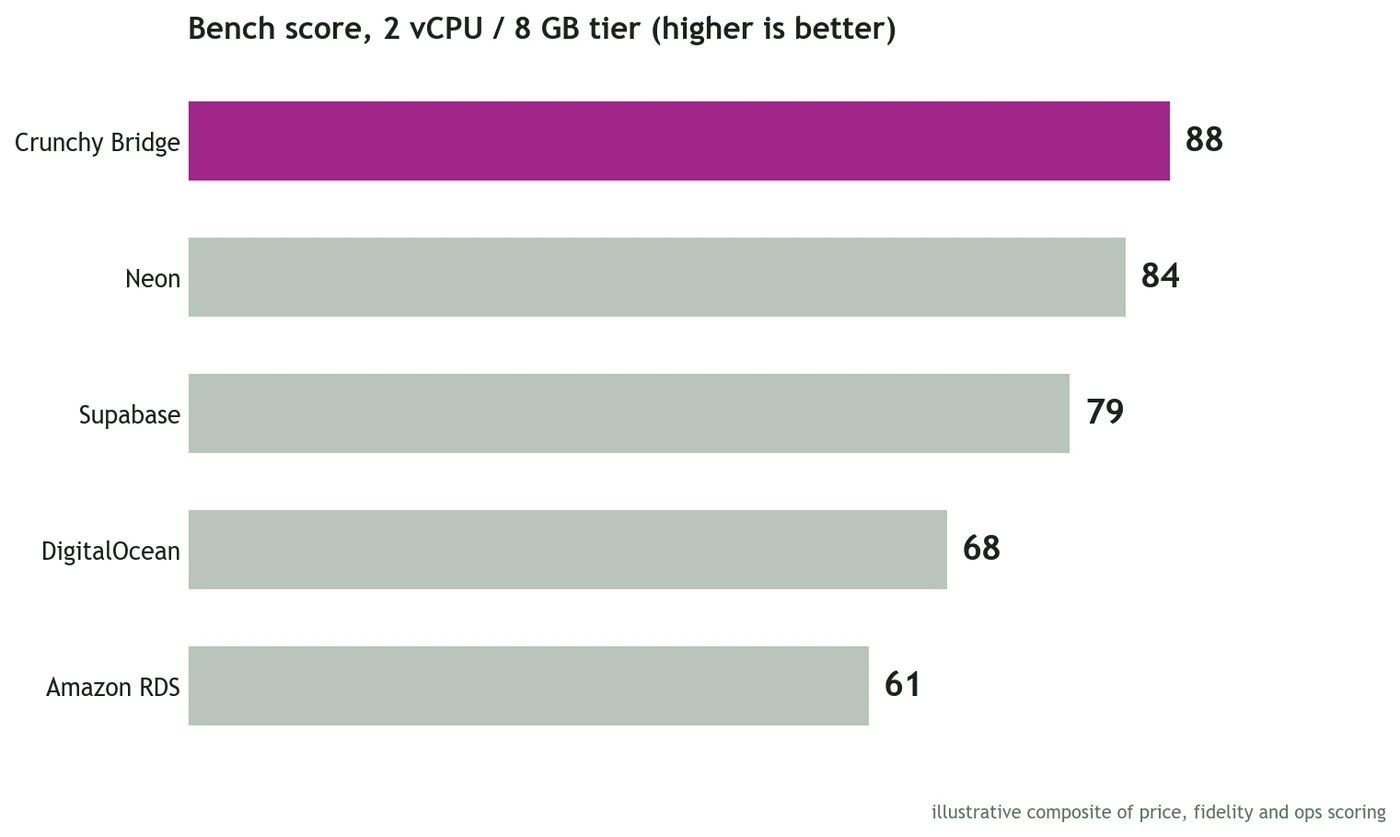
You want Crunchy Bridge for production and Neon for everything that isn't production yet. That's the verdict. The rest of this page is the receipts.
Criteria, written before scoring: monthly price for a 2 vCPU / 8 GB instance with 50 GB of storage, backup and restore behavior, connection pooling out of the box, and how much of vanilla Postgres survives the managed layer. Weights: price 40%, operational honesty 30%, Postgres fidelity 20%, extras 10%. Prices below are list, as of March 2026, from each vendor's public pricing page.
The table
| Rank | Provider | Entry price | The catch |
|---|---|---|---|
| 1 | Crunchy Bridge | ~$35/mo hourly-billed | Nothing exotic. That's the point |
| 2 | Neon | $19/mo Launch plan | Compute autosuspend needs tuning |
| 3 | Supabase | $25/mo Pro | You're buying a platform, not just Postgres |
| 4 | DigitalOcean | from $15/mo | Fewer extensions, slower Postgres releases |
| 5 | Amazon RDS | ~$15/mo before storage and IOPS | The bill is a research project |
Why the winner wins
Crunchy Bridge is run by Postgres people and it shows: logical replication works, extensions are current, and the docs assume you can read. You pay a little more than the neon-colored startups charge and you get a database that behaves like the one in the manual.
Neon's branching is the real thing, not a demo feature. A branch per pull request, paid per compute-second, is the correct way to run preview environments, and nothing else on this list does it as well. We just wouldn't autosuspend the primary of anything customers touch.
The skip
RDS, for teams under about ten engineers. Not because it's bad, but because the price on the pricing page is not the price. Storage, IOPS, backup retention and cross-AZ traffic arrive separately, and the console will happily let you provision something that costs four times the sticker. If you already live in AWS with a platform team, ignore this paragraph; that's who RDS is for.
Supabase is a fine product that we score as a platform, not a database. If you want auth and storage and realtime in the same invoice, move it up two places on your copy of this list.
What changed since we last looked
DigitalOcean stays on the list mostly for the $15 floor: it is the cheapest way to get automated backups and a failover story without reading an IAM tutorial. Extension support still trails the others, so check their coverage against your stack before committing.
Prices move; when they do, this entry gets updated and the change gets noted. If your bill disagrees with this table, tell the bench.