 The Canyon Review
pgvector vs. the dedicated vector databases, priced
For most teams the vector database is a Postgres extension you already have. The price check, the crossover point, and who should actually pay for dedicated.
You want pgvector. You already run Postgres, the extension is free, and a million embeddings with decent recall fits comfortably in the database you are already paying for. For most teams reading this, the vector database decision was made the day you chose Postgres, and the only news is that nobody told you.
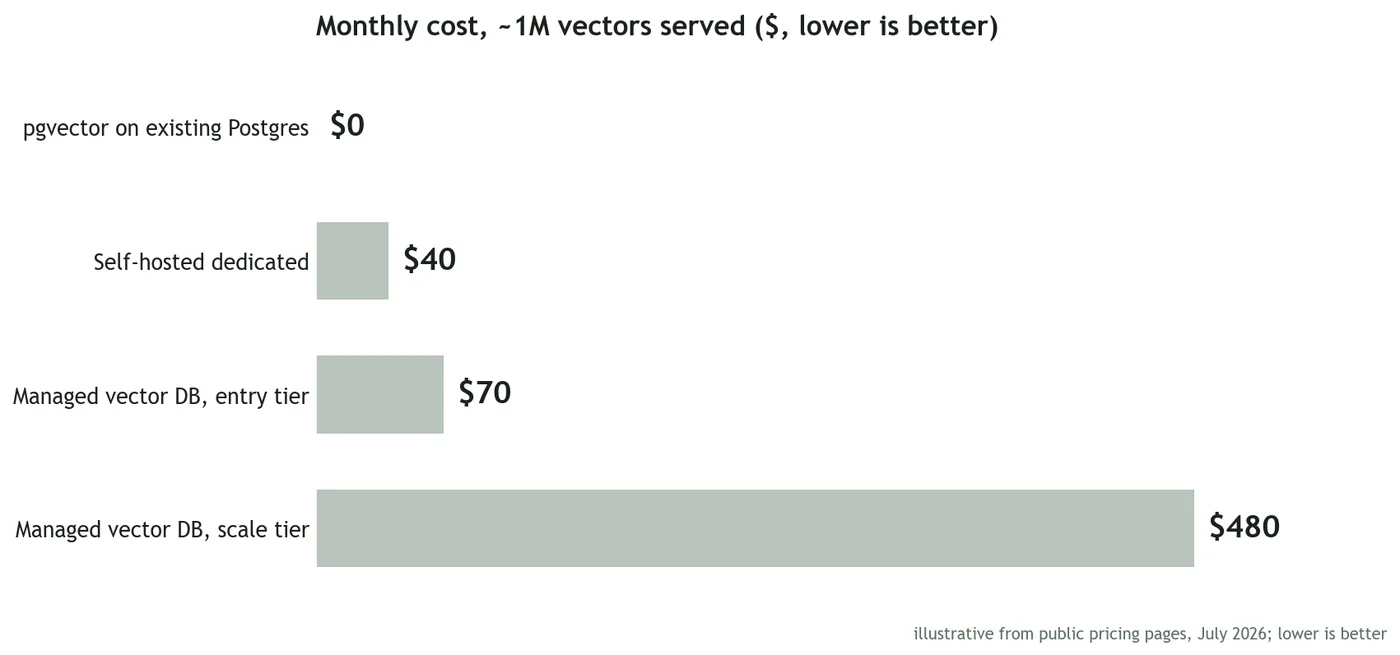
The dedicated services price by vectors stored and queries served; check Pinecone's current page for the going rates. Our chart shows the pattern (illustrative, July 2026): at the millions-of-vectors scale, the managed services cost real monthly money while pgvector rides along at roughly zero marginal cost on the instance you have. The dedicated tools are not overpriced. They are priced for a customer who is not you.
Who is that customer? Three honest profiles. Billions of vectors, where specialized indexes and memory management earn their keep. Hard latency floors at high query volume, where a purpose-built engine's tail behavior wins. And teams with no Postgres at all, for whom "just use the extension" is a migration proposal in disguise.
Everyone else: install the extension, build the index, measure recall on your actual queries. If the numbers disappoint, you have lost an afternoon and gained a benchmark to shop with.
Skip the dedicated tier until your vector count has three more digits than your user count. It usually never does.