 The Canyon Review
Gemini 4's December 1 price doubling, priced by service tier
Gemini 4 Carbon and Argon list at $2 in and $10 out through November 30, 2026, then $4 and $20. What one workload costs on each tier after the step, and which tier to move to.
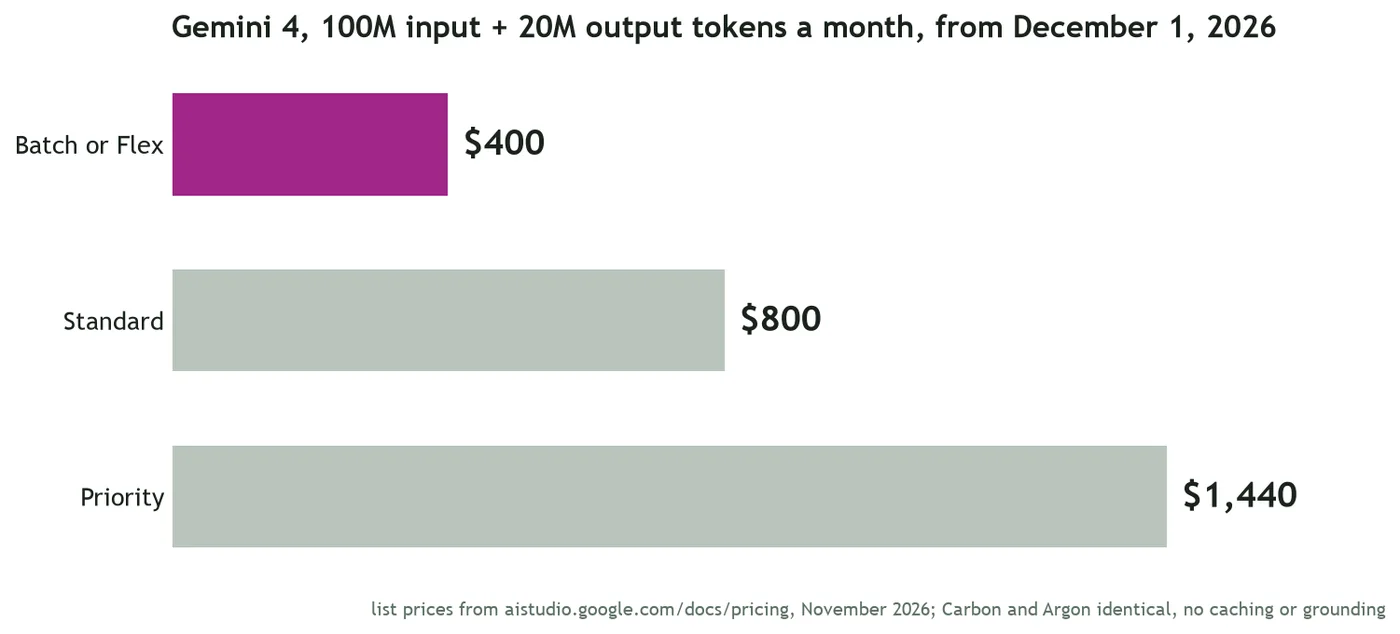
You want Batch or Flex. On December 1, 2026, both Gemini 4 models double on every tier, and the half-price tiers land exactly where Standard sits today. Work that can wait a few minutes keeps its November bill. Work that cannot pays twice.
The numbers are on Google's Gemini API pricing page, which prints each rate two ways: one figure "through November 30, 2026" and one "starting December 1, 2026". Gemini 4 Carbon and Gemini 4 Argon carry identical rates. Neither is on the free tier.
Criterion, stated before the table: monthly list cost of one workload, 100 million input tokens and 20 million output tokens, no caching, no search grounding. Desk research, prices as listed in November 2026. We did not run the workload. We multiplied.
The table
| Tier | Input / output per 1M, from Dec 1 | Workload through Nov 30 | Workload from Dec 1 |
|---|---|---|---|
| Batch | $2.00 / $10.00 | $200 | $400 |
| Flex | $2.00 / $10.00 | $200 | $400 |
| Standard | $4.00 / $20.00 | $400 | $800 |
| Priority | $7.20 / $36.00 | $720 | $1,440 |
Cached input doubles with everything else, from $0.10 to $0.20 per million on Standard, so a cache-heavy prompt does not escape the step. It just starts from a smaller number.
What the half-price tiers cost you in waiting
Batch and Flex are the same price and different products.
Batch is
asynchronous, with a target turnaround of 24 hours and its own
extended rate limits.
Flex is a
normal synchronous call with a 1 to 15 minute latency target,
requested by setting service_tier to flex. It is in
preview, it counts against your ordinary rate limits, and it
is sheddable: when capacity runs out you get a 503 or a 429,
with no fallback to Standard. Google's docs tell you to write
the retries yourself and to set client timeouts of ten minutes
or more.
So sort by patience. Nightly evals, backfills, document extraction: Batch. An agent loop where each step needs the last one's output and no human is watching: Flex, with backoff. A user looking at a spinner: Standard, at double.
Priority: skip it unless you measured the need
Priority is 1.8 times Standard on both sides of the step. What it buys is traffic the docs call "strictly non-sheddable". It is also in preview, and requests above your Priority limit are downgraded to Standard and billed as Standard. For our workload that is $1,440 against $800. You need an incident history worth $640 a month to justify it, and most teams have a hunch instead.
The verdict
Before December 1, tag every Gemini 4 call site as interactive or not. Move the second pile to Batch or Flex and its bill does not change. For the first pile, test Argon: Google describes it as spending fewer tokens per turn than Carbon, and at identical per-token prices that is the only saving on offer between the two.
One more date for the wall. The same page steps Gemini 3.8 Flash from $0.75 and $3.75 to $1.50 and $7.50 on January 1, 2027. Same move, one month later. Launch prices are deadlines, and deadlines go on the calendar.