 The Canyon Review
CI providers, priced on three real repos
GitHub Actions, GitLab, CircleCI and Buildkite priced against the same three repositories. The per-minute math nobody does before picking.
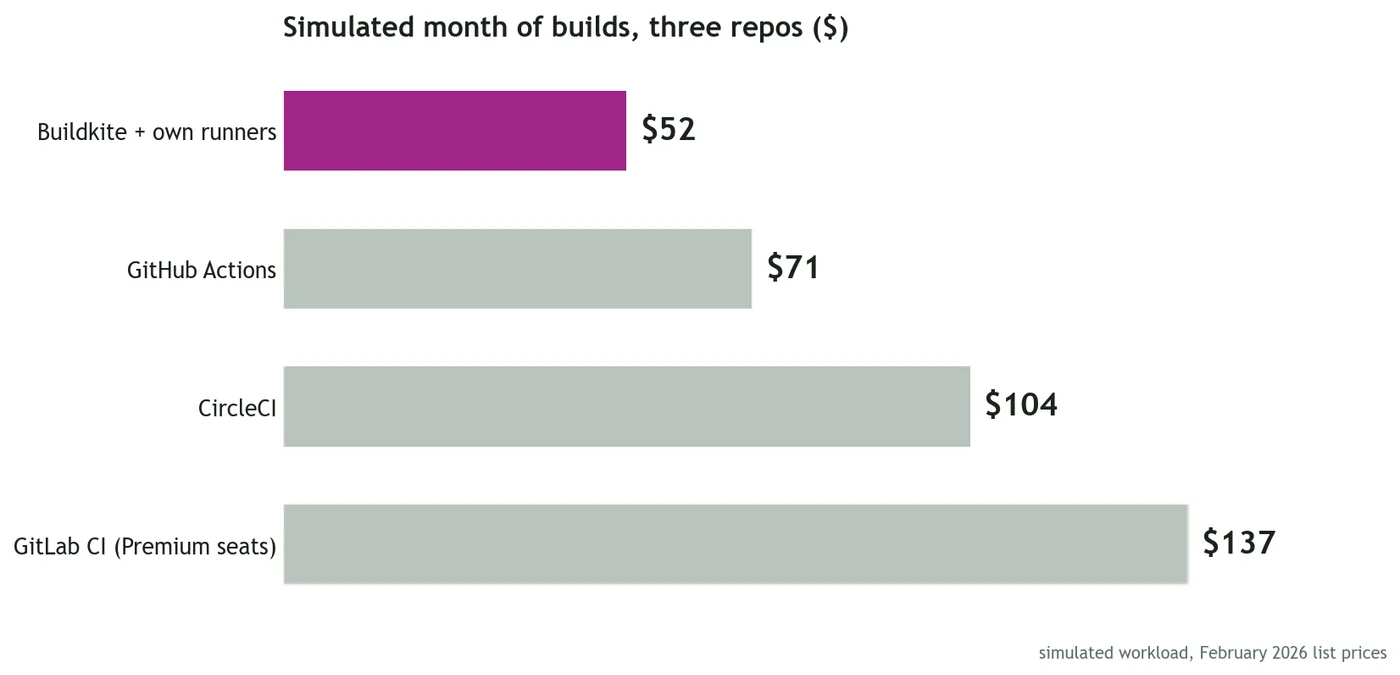
For a team of eight shipping a normal web product, GitHub Actions wins on price and loses on everything you'll want a year later. Buildkite is what we'd run. (Pick the pipeline first, then the feature flag platform that ships behind it; both are delivery spend you overbuy by default.) GitLab is what we'd run if we were also buying the rest of GitLab. That's the short version.
The pricing pages don't answer the only question that matters: what does a month of your builds cost? So we built a test matrix of three repositories and ran a simulated month (400 pushes, PR builds, nightly jobs) through each provider's calculator: a Go API with a ten-minute test suite, a React app with heavy dependency installs, and a small personal site carrying a pipeline much bigger than itself.
Criteria: simulated monthly bill 50%, runner flexibility 25%, config sanity 15%, lock-in 10%. Prices as of February 2026, list.
The table
| Rank | Provider | Simulated month | Notes |
|---|---|---|---|
| 1 | Buildkite | per-user fee + your compute | You bring runners; the bill is your cloud bill |
| 2 | GitHub Actions | ~$70 on hosted runners | $0.008/min Linux adds up quietly |
| 3 | GitLab CI | $29/user Premium + minutes | The platform tax cuts both ways |
| 4 | CircleCI | credit arithmetic | Fine product, pricing needs a spreadsheet |
The math that surprised us
The Go API cost about the same everywhere. The React app did not: dependency-install minutes on hosted runners are where the $0.008/min becomes real money, and caching discipline moved the simulated GitHub bill by a factor of two.
The small site cost pennies on every provider, which is why it's in the matrix, and it turned out to be the most instructive repo of the three. Its owner documented the GitHub Actions deployment pipeline behind it: type check, tests and a full build on every pull request, separate dev and production stacks with their own Lambda, bucket and CDN, and an invalidation step that diffs the deployed commit against a git tag so editing one page doesn't purge the site.
That is enterprise release engineering on a personal site, inside the free tier. Overkill, and the clearest illustration we've found of how far Actions goes at $0.
Buildkite's model (you pay per user, builds run on your own machines) looks more expensive on paper and was cheaper in every simulation past trivial scale, because a $40/month VM eats an enormous number of build minutes.
The GitLab caveat
GitLab CI remains the best-integrated system of the four. But CI stopped being purchasable alone: it rides on seats, and the 2023 Premium increase from $19 to $29 repriced the whole bundle. If you're on GitLab anyway it's excellent. Migrating to GitLab for CI alone doesn't survive the math.
The skip
Nothing here deserves a hard skip; CircleCI ranks last because credits are the least legible pricing unit in this market, not because the runners are slow. If a vendor makes you build a spreadsheet to predict the bill, that's a scoring penalty. It's also this site's whole reason to exist.